What Research Actually Says About Working Out on Your Period
You've probably skipped a workout or two because your period arrived and your body felt like it was staging a protest. Or you've pushed through and wondered whether you were helping yourself or making things worse. The answer — based on what current research shows — is clearer than most of what you've read about it.
The conversation around women's health and exercise has changed meaningfully in the last few years. Research that was once thin because women have been chronically underrepresented in sports science studies is now more specific and more honest. What's coming out is worth knowing if you train consistently and want to stop second-guessing yourself every month.
Your Body Can Train Through Your Cycle
Researchers at McMaster University published findings in 2025 showing no noticeable difference in how women's bodies built or broke down muscle tissue across different phases of the menstrual cycle. That's a significant finding. It means the body's capacity for strength adaptation stays consistent, regardless of where you are in your cycle.
That doesn't mean every workout will feel the same. It means your body is physiologically capable of making progress throughout the month. Perceived performance and actual performance are not the same thing — and research increasingly shows that separating them matters.
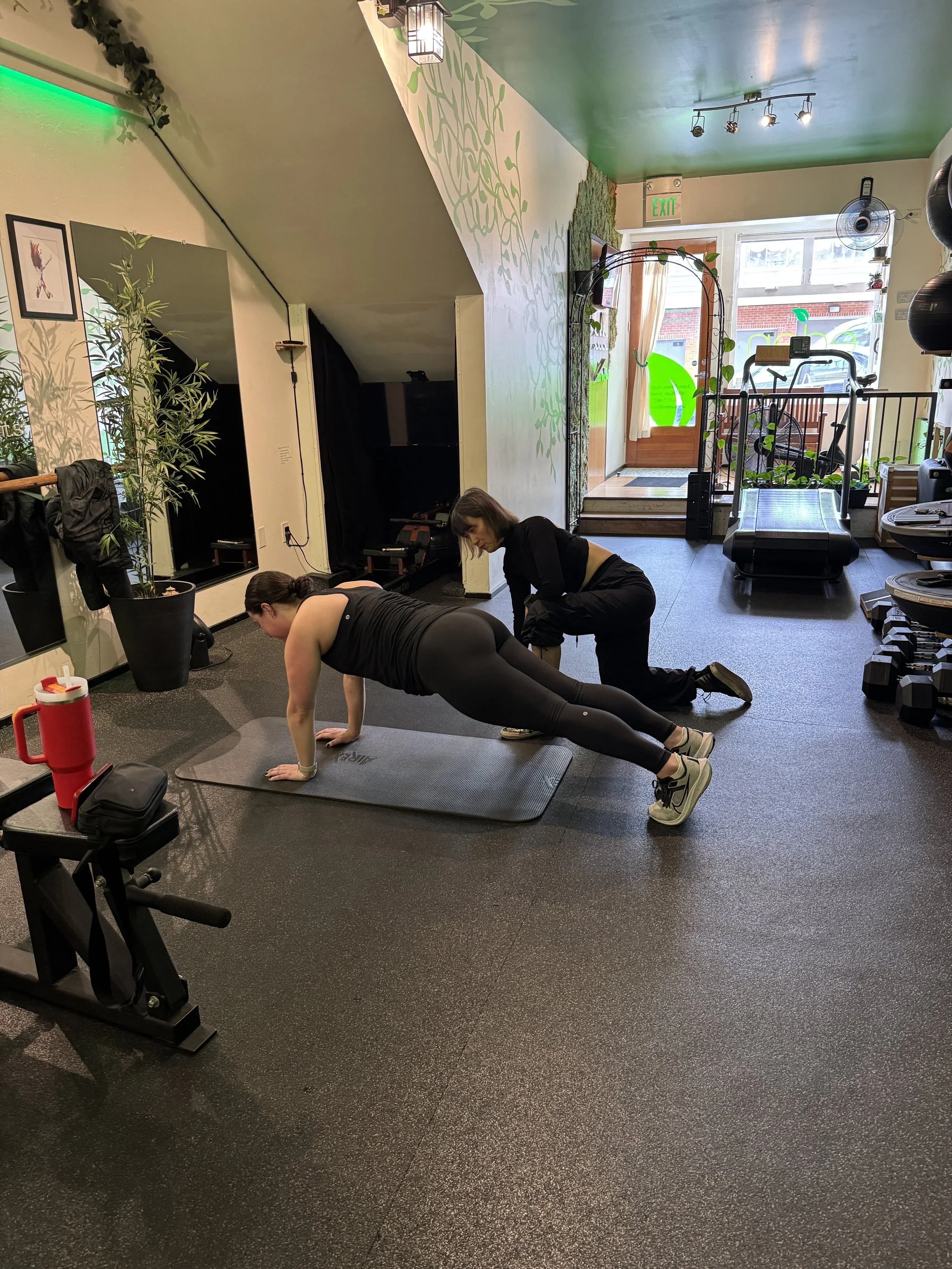
At Eden Fitness Studio, we work with women across all stages of life, and this question comes up more often than most trainers acknowledge. The experience of training during your period is real — and so is the fact that it doesn't have to mean backing off entirely.
What the Data Shows on Perceived Performance
A significant portion of women — roughly 56% in studies reviewed by the American Council on Exercise — report a drop in how they feel during the first days of their period. The feeling is common and valid. Bloating, cramping, fatigue, and low mood are real physical experiences.
But feeling different is not the same as performing differently. Multiple peer-reviewed studies, including a 2025 Frontiers in Endocrinology narrative review covering hundreds of studies, found that results across menstrual cycle phases are inconsistent enough that no single blanket recommendation applies to everyone. Some women perform best right at the start of their period. Others feel strongest in the late follicular phase. Individual variation is wide.
Harvard's Apple Women's Health Study, which analyzed over 22 million workouts from more than 110,000 participants, is still generating findings — but early data points in the same direction: exercise habits vary across the cycle, but performance outcomes are not uniformly worse during menstruation.
What Does Change (And How to Work With It)
Hormone fluctuations across your cycle do affect certain physiological processes. Estrogen levels in the follicular phase support muscle protein synthesis, which means the first two weeks of your cycle may offer a slight edge for strength work. Progesterone in the luteal phase can affect body temperature regulation and perceived effort — you might feel like you're working harder at the same intensity.
These are real effects. They're not dramatic enough to require a complete restructuring of your training calendar. Adjusting intensity on days when you feel off — going for a moderately heavy session instead of a max-effort day — is a practical, reasonable response. Canceling training entirely because of your cycle is a different calculation, and for most women, it's not necessary.
A 2025 randomized controlled trial published in PMC found that consistent physical activity is associated with reduced cramps, better sleep quality during menstruation, and lower overall symptom severity over time. Movement tends to help, not hurt.
Listening to Your Body — But Honestly
There's a version of "listening to your body" that's useful, and a version that's just avoidance. They can look identical from the outside.
The useful version: you wake up on day one with significant pain, minimal sleep, and a migraine. A lighter session or a rest day is a measured, reasonable call.
The other version: you feel a little tired and bloated, and the couch sounds better than the squat rack.
The research doesn't tell you which version applies on any given day. It does tell you that your body is capable of training through your cycle, that results accumulate over time, and that the weeks you show up imperfectly still count.
A trainer who understands women's physiology can help you make that call with more accuracy than a rigid rule that applies the same solution to every symptom. This is part of why working with a female personal trainer at Eden looks different from following a downloaded program. The conversation about how you're feeling — and what that means for today's session — is part of the training.
Practical Things Worth Knowing Before Your Next Session
There's no evidence that you need to avoid specific exercises during your period. Lifting, running, HIIT, strength work — all of these are safe. Cramps are often worsened by dehydration, so training during your period means paying closer attention to water intake than usual.
If your period symptoms are severe enough that training consistently during menstruation feels impossible — heavy bleeding, debilitating cramps, significant fatigue — that's a clinical picture worth discussing with a doctor. Exercise can help manage normal menstrual discomfort. It's not a substitute for medical evaluation when something more serious is happening.
The Cycle-Syncing Question
The popularity of cycle-syncing content on social media has outpaced the research. Most of what gets promoted as evidence-based phase training is based on preliminary studies with small sample sizes, extrapolated far beyond what the data support.
That doesn't mean paying attention to how you feel across your cycle is wrong. It means the prescriptive protocols — "don't lift during your luteal phase," "only do yoga the week before your period" — are not grounded in current research. What the research does support: consistent training over time, adjusted thoughtfully when needed, produces results. Your period is one variable among many. Treat it that way.
If you've been restructuring your training around cycle protocols and wondering why the results are inconsistent, this is likely why. The more reliable path is showing up regularly, adjusting intensity when your body calls for it, and building the kind of relationship with training that holds up through the full month.
Ready to train with someone who gets women's physiology? Schedule a tour of Eden Fitness Studio and meet the team in person. Eden is a private women's gym in San Francisco — no co-ed floor, no waiting for equipment, and trainers who have real conversations about how to train through every stage of your life. When you come in, you'll see the space, meet the team, and leave with a clear sense of what it's like to train here.
This article is meant to inform, inspire, and support your wellness journey, not to replace professional medical advice. Please consult with your licensed healthcare provider before making any changes to your health or fitness routine, especially if you're taking prescription medications. Read our full Terms & Conditions.